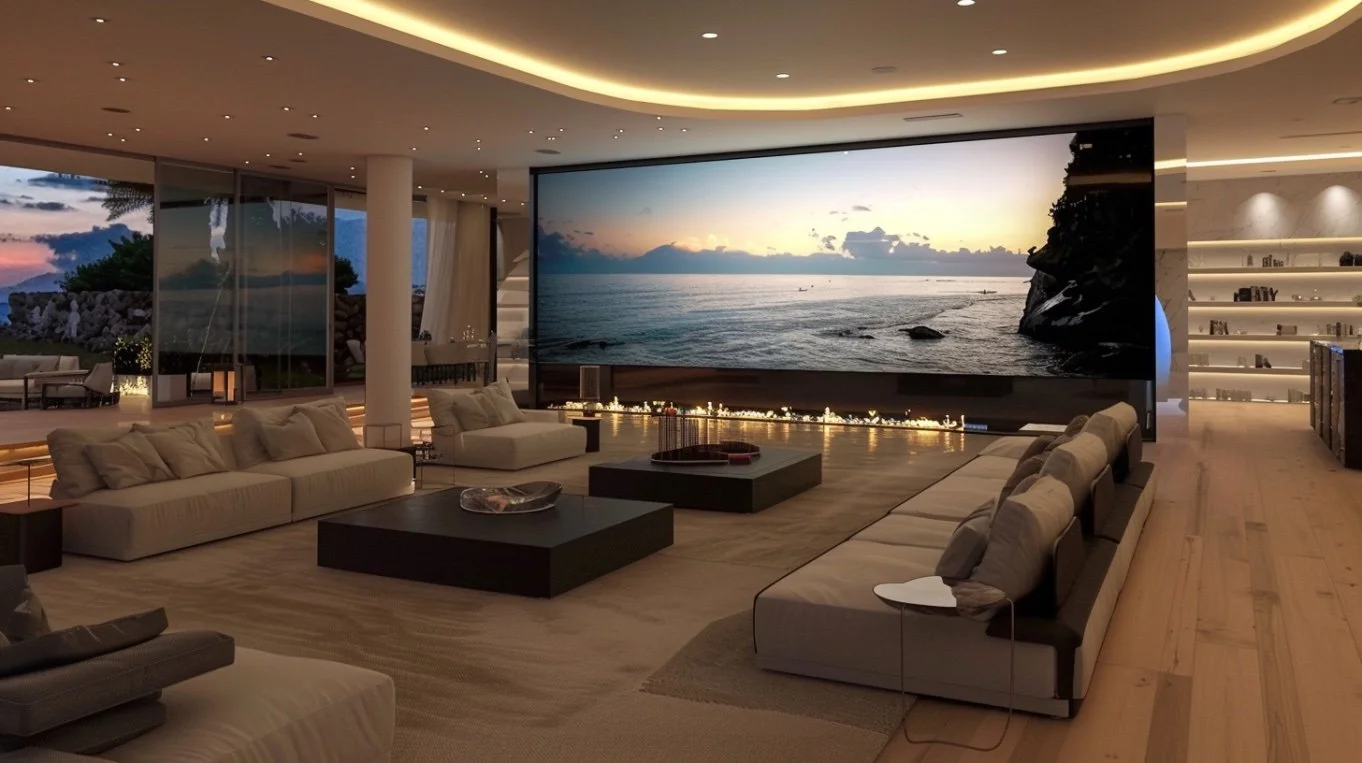
The end of the projector.
A cinema screen that makes its own light. No bulb, no throw distance, no darkened room. Micro LED built into the architecture of the house, specified alongside your architect and integrator.
LED versus projection.
Projection was a compromise the room had to be built around. Direct-view LED removes the compromise. Here is the honest version, including where a projector still wins.
| Micro LED | Projection | |
|---|---|---|
| Ambient light | Holds full contrast in a lit room | Needs the room blacked out |
| Black level | Pixel is off, so black is black | Grey lifted by scattered light |
| Room design | 29.5mm deep, sits in the wall | Throw distance dictates the layout |
| Maintenance | No bulb, no filter, panel-level service | Lamp or laser replacement, filters |
| Noise | Silent at the screen, rack remote | Fan noise in or near the room |
| Dual use | Art, architecture or ambience when off-duty | A blank screen |
| Where projection wins | — | Lower cost per square foot above 200 inches, in a dedicated blacked-out theatre |
One surface, three lives.
A residential LED wall is rarely bought for film alone. It earns its place because it is three things in one architectural opening.
01 / Cinema
The screening room.
Reference-grade image at full brightness with the lights up. Calibrated to the seating plan, matched to the room’s acoustics and integrated with the control system you already run.
02 / Gallery
The collection wall.
Between screenings the same surface becomes a digital canvas for a rotating collection. Sub-millimetre pitch holds up at gallery viewing distance, not just across a room.
03 / Architecture
The living surface.
Ambient environments, a window that is not a window, a fireplace that is not a fireplace. Off-duty the wall becomes part of the interior rather than a black rectangle in it.
Built to be drawn in.
Setting-out drawings, structural backing, power and thermal loads issued at design stage so the screen and the millwork are coordinated before anything is built.
For architects and integrators.
Most of our residential work arrives through the people drawing the room, not the people living in it. We are set up for that.
Trade pricing, CAD and Revit blocks, full specification documents, thermal and electrical loads, and a named contact who will attend design meetings. We issue what your consultant needs to coordinate the trade, and we do not go around the specifier on their own project.
Sizing the room.
Pixel pitch is matched to the closest seating row, not to the size of the wall. As a working rule, minimum comfortable viewing distance in metres is roughly the pitch in millimetres.
At 1.2mm the front row can sit around 1.2 metres back before structure becomes visible. Most residential cinemas land between 0.9mm and 1.5mm depending on where the first row sits.
Concept to commissioning.
Before you specify.
Is LED better than a projector for a home cinema?
How much does an LED home cinema screen cost?
What pixel pitch do I need for a home theater?
Can an LED wall be recessed flush into the architecture?
How hot and how loud is a residential LED wall?
Do you work directly with architects and AV integrators?
Send us the room.
Drawings, a sketch, or just the dimensions and where the front row sits. We will come back with a sized specification and a budget range inside 24 hours.